Words hold immense power. Within every word lies not only its current meaning but also traces of its origins and history. For bilingual individuals and polyglots, words often carry additional layers of meaning, as they are connected to similar words, expressions, and concepts across multiple languages.
This creates a vast network of linguistic connections. Words become linked through patterns, shared roots, and cultural influences, forming an intricate web that spans different languages and societies. Through these connections, language can be seen as both a record of the past and a glimpse into the future. The relationships between languages reveal their origins while also hinting at how they may continue to evolve as human cultures become increasingly interconnected.
As people speak multiple languages, new forms of communication naturally emerge. Languages influence one another, borrowing vocabulary, grammar, and expressions. Over time, this process can lead to the creation of entirely new linguistic systems that combine elements from several existing languages.
One could imagine many different combinations of languages. For example, the blending of Polish and German might create a hybrid language that could be called “Polman,” while the combination of German and English might become “Gerlish.” The possibilities are nearly endless, and even mixtures of three or more languages could develop. Such linguistic hybrids would reflect the diverse experiences and identities of multilingual speakers.
From a neurolinguistic perspective, the brain creates pathways that connect different languages. These pathways allow multilingual individuals to switch between languages, borrow concepts from one language to another, and unconsciously form new combinations of words and meanings. In the subconscious mind, languages are not always separate systems but interconnected networks that constantly interact.
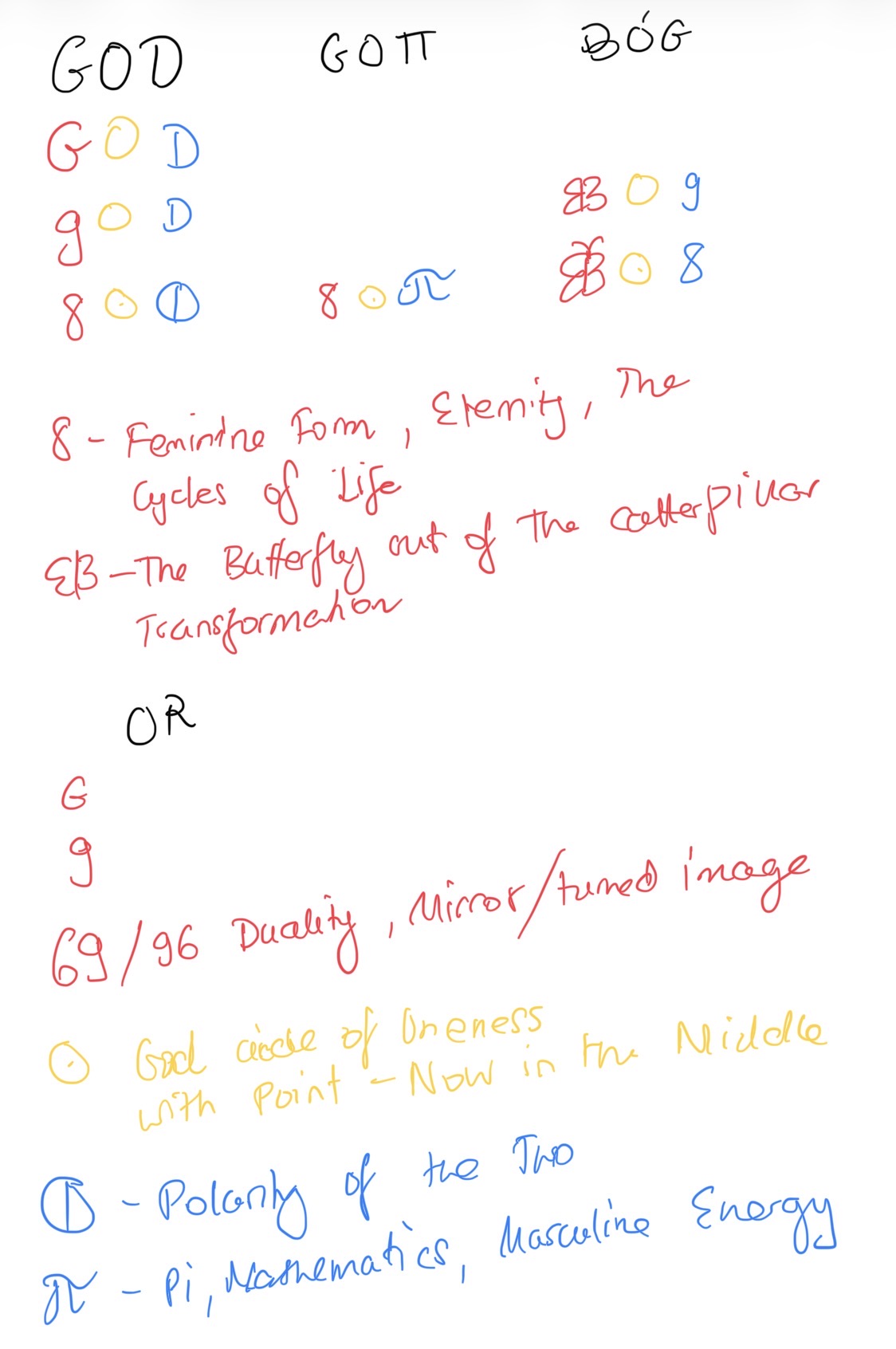
Beyond spoken and written words, language can also be understood through signs and symbols. Letters, numbers, and other visual representations function as forms of sign language that convey meaning. Exploring these symbols broadens our understanding of communication and reveals additional layers of how humans interpret the world.
Through this broader perspective, language becomes more than a tool for communication. It becomes a living system that connects people across cultures, histories, and generations. By studying the connections between languages, symbols, and meanings, we gain a deeper understanding of the shared human experience and of the world as it is known across humanity.
Here is an example of the word God in English, German and Polish and how it can be turned into a symbolic representation.